
When designers Kharis O’Connell and Ryan Betts attended GROW, the largest tech conference in Western Canada this year, they felt they were the only designers in the room. “Vancouver design is so insular,” Kharis noted. “Where are they all?”
This feeling of industry isolation is not unique in Vancouver. It is well documented by now that social isolation permeates industries, cultural groups, and neighbourhoods across the city. Kharis and Ryan agreed that better communication and inclusivity would improve the quality of design in the city. But how can community members help build inclusivity when they are so busy trying to make their businesses work?
When I spoke with the founders of design agency Denim and Steel, Todd Sieling and Tylor Sherman, about this challenge, they agreed that something should be done to open a conversation about design in Vancouver. “How do we level up the design community?,” we asked. “And how can we tell its story?”
Opening the Conversation
Todd and Tylor, and facilitator Amanda Fenton and I had already organized a community roundtable event for the tech startup community last March. “What do you think,” I asked them, “of doing the same thing but for design this time?” They agreed, and Kharis, Ryan, Jennifer Cutbill of Vancouver Design Week and Amanda Fenton and I started putting the pieces together for last Tuesday’s event Telling Vancouver’s Design Story. When Spring, a local accelerator, donated their secondary venue for the discussion, we had everything in place.
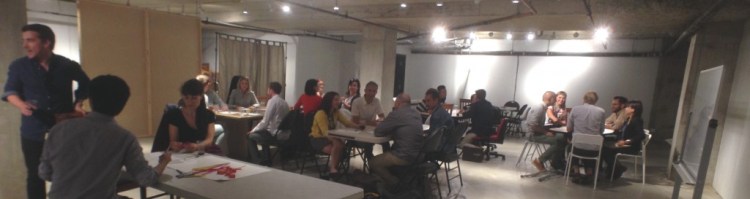
Upon their arrival, we asked attendees – designers from various sectors in Vancouver – to interview each other about the experiences they had getting to know the design community in Vancouver. “Imagine if you were newly here in Vancouver,” the first question went, “who would you connect with? Where would you find your community? And what would you be looking for? What is missing? What could help that?” And a second question: “Tell a story of a time where you felt particularly connected to Vancouver’s community and what was the positive impact of that? If you have yet to feel connected, how do you go about finding connection locally?”
Then we asked the group of forty attendees three questions, to answer in groups of five:
- I’d like to welcome you to share what you heard in the stories of connection. What is common about those stories? What is something that connects designers in Vancouver? Think about what do you value most? What attracts designers to Vancouver? (other than the quality of life or ‘Beautiful BC’) I’d like to invite you to describe how or why these assets and qualities are beneficial to designers.
- What do we need to know that could transform the health of the Vancouver design community for the better – help it realize its potential? (not what we need to BE, what do we need to KNOW). If we had that information, how would you use it?
- What is something you would like to see in Vancouver, and what kind of projects would you like to work on?
After the groups exchanged ideas for about twenty minutes for each question, we asked a member of each group to speak to the room about what they had heard. This launched a fifteen minute conversation about each question. At the same time, participants were writing down their opinions and ideas on sticky notes for the wall, and tweeting #VanDesignStory tweets. Amanda calls this the “harvest.”
What We Heard
We were surprised to hear a consensus in the crowd. Yes, the design community could do a better job of welcoming people. Yes, we could be communicating to each other and to businesses in a more effective way.
We found, however, that there was a great deal of optimism around what could be done to improve the state of design in Vancouver, and that people were willing to collaborate to build projects. These ideas included a Critique Club, where you could get honest and straightforward feedback on your work; a “goodwill” competition, where agencies could work on improving the state of certain business’ web design; and an agency directory, so that newcomers could easily find who to talk to in town.
Takeaways
Names and contact information were exchanged by the end of the evening, and various groups left for the pub or to drive each other home. The evening left with a buzz – who would work on what next?
For me, the evening was a success, thanks to the research questions and the people who attended. The importance of phrasing the right question is so key to getting to the important parts of a conversation. I also learned that when you ask the right questions, it’s hard to break people out of conversation. Sometimes, that was ok – the discussions were lively. Amanda had said to bring a bell to announce the next activity. I won’t be forgetting that next time.
Finally, the two roundtable events that we’ve done have tended to go quite long – two and a half hours to three. Better food for dinner is a must for certain attendees, and although I wrote about ‘only snacks’ being available on the invite page, I think that over dinner time, it’s better to feed people than to have them pick at cookies and chips.
What is Vancouver’s Design Story? It is what we make of it. If you’d like to be a part of an ongoing discussion, please sign up for this newsletter to find out about upcoming events like this one. If you know anyone who is interested in this kind of thing, too, I’d love to talk to them about building industries with intention.
 Claire Atkin